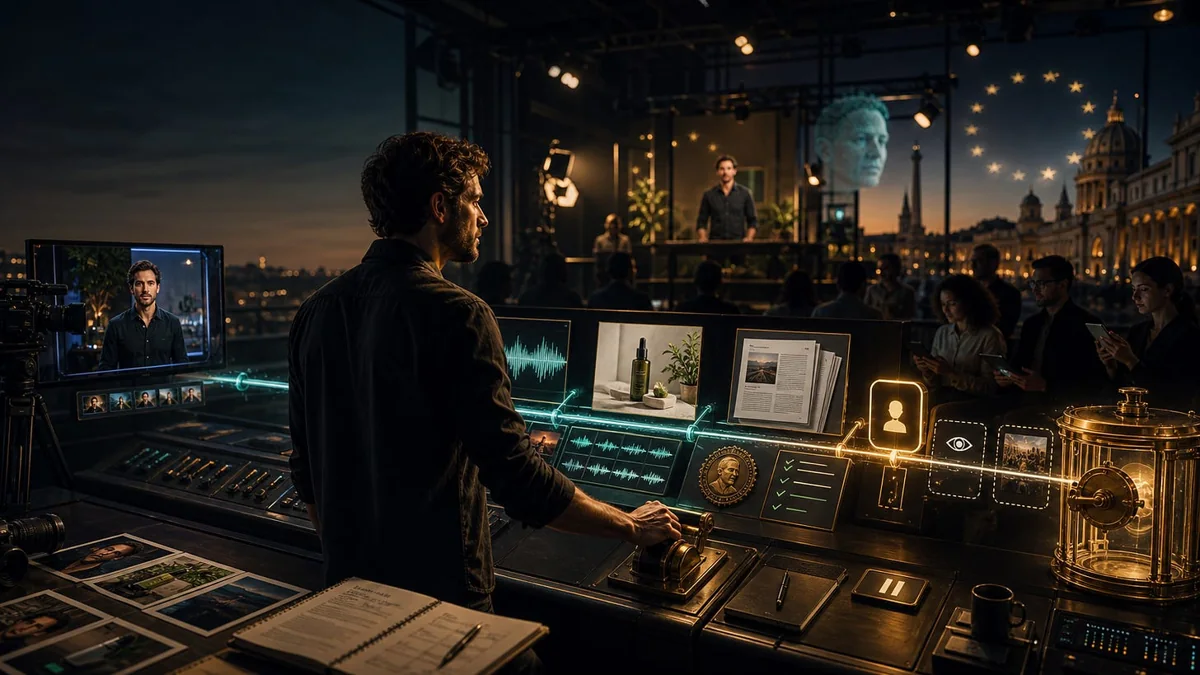
If you use AI to make a realistic image, clone a voice, or help draft a public post, the hard part often comes at the end: do you need to tell people AI was involved, and where should that notice go?
This guide is for U.S.-based solo creators and small-business owners who publish to a public website, social platform, video channel, course, or product page that may reach people in Europe. By the end, you will have a simple check for deciding when a clear disclosure belongs in the content, when human review matters, and when the question needs legal help.
This is a practical screening tool, not legal advice. The EU rules are new, the facts of a project matter, and a public checklist cannot decide whether a specific business is legally in scope.
What changed in August
On August 2, 2026, transparency obligations in Article 50 of the EU AI Act began to apply. The European Commission has published guidance for providers and deployers of certain AI systems, plus optional icons for labeling AI-generated or manipulated content. As of this September review, the EU AI Act Service Desk warns that the Article 50 text shown on its page has not yet been updated for later Digital Omnibus amendments. Treat this checklist as a way to spot questions, then check current official guidance or get legal advice for a real publication decision.
The distinction between provider and deployer is useful. The company that builds an AI image or voice tool may have technical marking duties. The person or business that uses the tool and publishes the result can have a separate duty to tell the audience what it is seeing. A platform label or hidden metadata should not be treated as an automatic substitute for your own review.
For everyday creators, the clearest examples involve deepfakes: AI-generated or manipulated images, audio, or video that resemble real people, objects, places, or events and could falsely appear authentic. The rules also address AI-generated text about matters of public interest when it is published without human review or editorial responsibility.
The four-part disclosure check
1. Start with what the audience could believe
Ask what a reasonable viewer might think is real. Did AI make a person appear to say words they never recorded? Did it place a real product in a real-looking room that never existed? Did it substantially alter footage of a real event? The more the result borrows the credibility of a real person, place, object, or event, the stronger the case for a clear disclosure.
Do not begin with the percentage of pixels AI changed. Begin with the impression the final piece creates.
2. Separate realistic media from ordinary assistance
Using AI to correct spelling, remove a background, resize an image, or brainstorm a title is not the same as publishing a synthetic version of a person or event. The Commission’s guidance recognizes exceptions and examples involving standard editing, but that phrase is not a blanket pass for every edit.
Write down the original material, the AI change, and what a viewer sees. If the change is substantial or creates a false appearance of authenticity, do not bury that fact inside your production notes.
3. Treat text and realistic media as different questions
Article 50 includes an exception for AI-generated text on matters of public interest when the text has gone through human review or editorial control and a person or legal entity takes editorial responsibility. That makes a real editing process important: checking facts, changing weak language, verifying sources, and owning the final publication.
That text exception does not erase the separate disclosure question for deepfake image, audio, or video. A human can review a synthetic spokesperson clip and still need to disclose that the voice or likeness was generated or manipulated.
4. Put the notice where people encounter the content
The rule calls for information that is clear, distinguishable, and accessible at the time of first interaction or exposure. The Commission’s optional icons are one possible method, not proof of compliance by themselves. Its practical guidance also favors plain language and accessible placement.
For a creator, that means the notice should travel with the content. Put it on screen when the synthetic person or scene first appears, in the caption beside an image, or next to the relevant text. A vague statement on a distant policy page is easy for an audience to miss.
A worked example: the AI version of you
Suppose you record a short tutorial, then use an AI avatar and voice model to produce a translated version. The avatar looks like you and speaks words you did not record in that language.
First, name the audience impression: viewers could reasonably believe they are watching an ordinary recording of you. Second, record the change: the voice and likeness were generated for the translated version. Third, keep a human review step for the translation, pronunciation, product claims, and final edit. Finally, use direct language at the first appearance, such as: ‘This translated demonstration uses an AI-generated version of my voice and likeness.’
You could repeat a shorter label in the description and keep a production note with the tool used, date, approver, and final disclosure. The record will help if the content is clipped, corrected, or reused later.
What to do this week
Pick one public piece of AI-assisted content you already publish: a video, listing image, course lesson, ad, or article. Save a copy and answer four questions: What could the audience believe is real? What exactly did AI change? Who reviewed and accepted responsibility for the finished piece? Where will the audience see the disclosure at first exposure?
If you cannot answer one of those questions, pause the publication and fix the gap. If the project serves European customers, imitates a real person, covers a matter of public interest, or could affect someone’s purchase or trust, ask a qualified attorney about your specific facts.
Even when a label is not legally required, a short, accurate disclosure can be the better trust decision. The goal is not to attach ‘made with AI’ to every spell-check. It is to keep people from mistaking a meaningful synthetic change for an authentic recording, image, or event.
Sources
European Commission - EU Icons for labelling AI-generated content
Associated Press - EU to crack down on AI deepfakes, illicit imagery and hacking